




Health & Wellness
Complete Guide to Bed Support Solutions for Back Pain Sufferers

A Comprehensive Resource for Lower Back Pain Relief Through Proper Sleep Positioning and Support
Executive Summary
Lower back pain affects approximately 619 million people globally as of 2020, with projections estimating 843 million cases by 2050 according to the World Health Organization. This guide provides evidence-based bed support solutions designed to alleviate back pain through optimal sleep positioning, mattress selection, and supportive accessories. Drawing from clinical research, expert recommendations, and real user experiences from platforms including Reddit, this resource offers actionable strategies for achieving restorative sleep while managing back discomfort.
Key Takeaways:
- Medium-firm mattresses typically provide optimal support for back pain sufferers
- Side sleeping with a pillow between knees reduces spinal pressure by up to 50%
- Proper lumbar support accessories can significantly improve sleep quality
- Adjustable beds offer customizable positioning for personalized pain relief
Table of Contents
- Understanding Back Pain and Sleep Connection
- Optimal Sleeping Positions for Back Pain Relief
- Mattress Selection Guide for Back Pain
- Essential Support Accessories
- Adjustable Bed Solutions
- Pre-Bedtime Routines for Back Pain Management
- Real User Experiences and Community Insights
- Frequently Asked Questions
- Conclusion and Action Plan
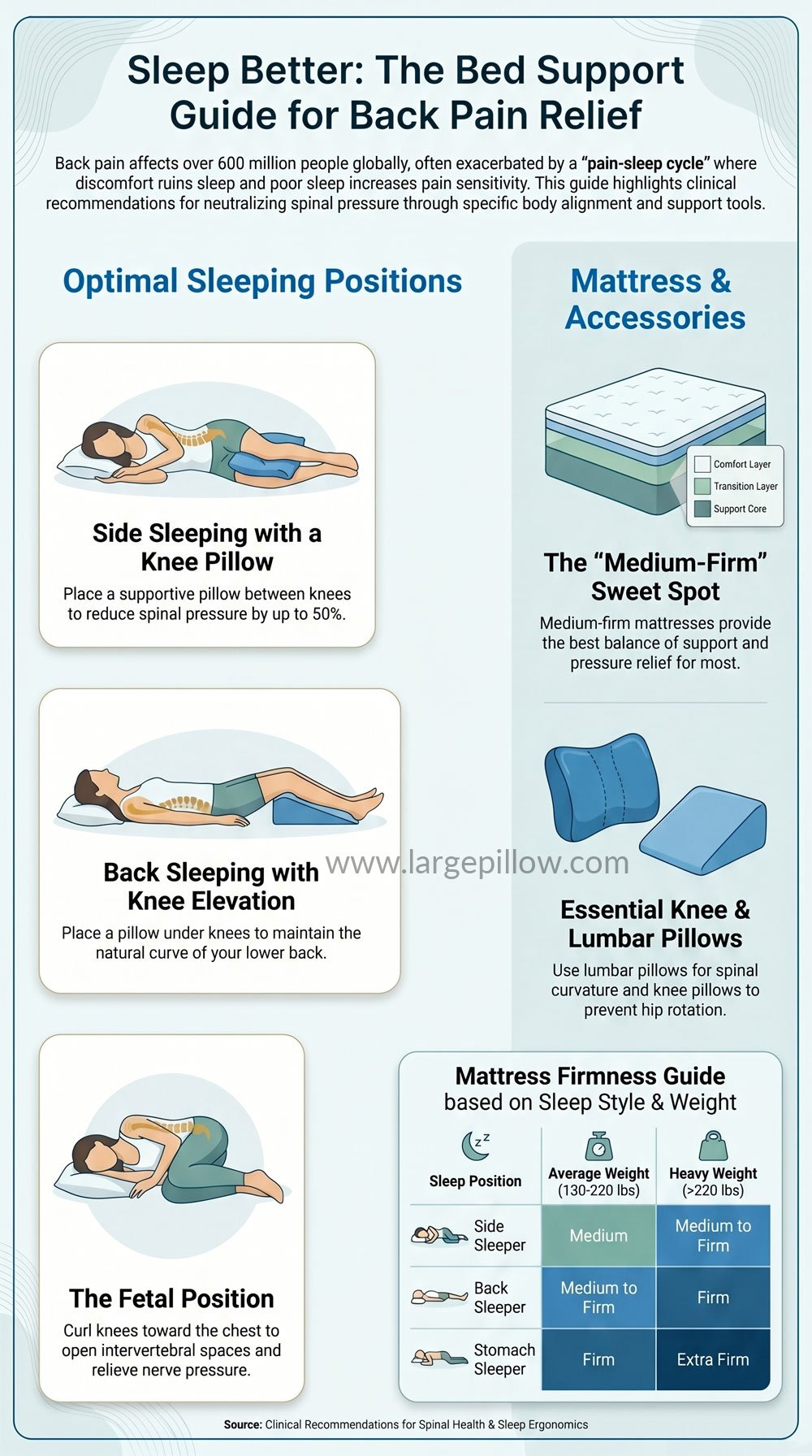
Understanding Back Pain and Sleep Connection
The Pain-Sleep Cycle
Research published in the National Center for Biotechnology Information demonstrates a bidirectional relationship between pain and sleep. Back pain disrupts sleep quality, while poor sleep increases pain sensitivity, creating a challenging cycle that affects millions worldwide.
How Sleep Affects Back Pain:
- Inadequate sleep increases inflammatory markers in the body
- Poor sleep positions place uneven pressure on spinal discs
- Lack of quality sleep reduces the body’s natural healing processes
- Sleep deprivation heightens pain perception thresholds
Common Causes of Lower Back Pain
Understanding the root cause of back pain helps determine the most effective bed support solutions:
| Cause | Description | Recommended Support Solution |
|---|---|---|
| Muscle Strain | Overexertion or improper movement | Medium-firm mattress, lumbar pillow |
| Porckorongsérv | Disc material pressing on nerves | Fetal position sleeping, adjustable bed |
| Degeneratív porckorongbetegség | Natural breakdown of spinal discs | Supportive mattress, knee pillow |
| Gerincszűkület | Narrowing of spinal canal | Elevated leg position, firm support |
| Isiász | Sciatic nerve compression | Side sleeping with knee pillow |
| Poor Posture | Sedentary lifestyle effects | Full-body support system |
Optimal Sleeping Positions for Back Pain Relief
Position 1: Side Sleeping with Knee Pillow (Recommended)
Effectiveness Rating: 9/10
Side sleeping with a pillow between the knees is widely recommended by orthopedic specialists and consistently praised in user communities for maintaining spinal alignment.
Benefits:
- Maintains natural spine curvature
- Reduces pressure on the lower back
- Prevents hip rotation during sleep
- Distributes body weight evenly
How to Optimize:
- Lie on your preferred side
- Place a supportive pillow between your knees
- Draw knees slightly toward your chest
- Ensure your head pillow keeps your neck aligned with your spine
- Consider a testpárna for additional support
Expert Tip: According to Dr. Raymond J. Hah, a spine surgeon at Keck Medicine of USC, side sleeping helps maintain the natural lordotic curve of the spine, reducing strain on lumbar muscles and joints.
Position 2: Back Sleeping with Knee Elevation
Effectiveness Rating: 8/10
Back sleeping allows for even weight distribution across the body’s widest surface area, promoting proper spinal alignment when combined with knee elevation.
Benefits:
- Even weight distribution
- Neutral spine position
- Reduced pressure points
- Suitable for upper back pain
How to Optimize:
- Lie flat on your back
- Place a pillow under your knees to maintain the natural curve of your lower back
- Optionally, roll a small towel and place it under the small of your back
- Use a supportive pillow that keeps your head aligned with your spine
Clinical Evidence: A study published in BMC Public Health found that 63% of participants reported significant improvement in lower back pain after optimizing their sleep system, including proper positioning.
Position 3: Fetal Position
Effectiveness Rating: 8.5/10 (for specific conditions)
Particularly beneficial for individuals with herniated discs or spinal stenosis, the fetal position opens space between vertebrae.
Benefits:
- Opens intervertebral spaces
- Relieves pressure on nerve roots
- Reduces tension on spinal discs
- Effective for sciatica relief
How to Optimize:
- Lie on your side
- Draw knees up toward your chest
- Curl your torso slightly forward
- Support your head with an appropriate pillow
- Alternate sides to prevent muscle imbalances
Position 4: Back Sleeping with Elevated Legs
Effectiveness Rating: 7.5/10
This position promotes relaxation of lower back and pelvic muscles while enhancing circulation.
Benefits:
- Relaxes lower back muscles
- Enhances blood circulation
- Reduces inflammation
- Decreases swelling in lower extremities
How to Optimize:
- Lie flat on your back
- Elevate legs using pillows or an adjustable bed
- Keep knees slightly bent
- Avoid elevating legs too high to prevent pelvic strain
Position to Avoid: Stomach Sleeping
Effectiveness Rating: 2/10
Medical professionals consistently advise against stomach sleeping for back pain sufferers. This position flattens the spine’s natural curve and forces neck rotation, potentially causing additional pain.
If You Must Sleep on Your Stomach:
- Place a thin pillow under your pelvis to maintain lower back curvature
- Use a very thin or no pillow under your head
- Consider transitioning to side sleeping using the tennis ball technique (place a tennis ball in a front shirt pocket to discourage stomach sleeping)
Mattress Selection Guide for Back Pain
Understanding Mattress Types for Back Pain
Selecting the right mattress is crucial for back pain management. Research indicates that mattress choice significantly impacts sleep quality and pain levels.
Memory Foam Mattresses
Best For: Pressure point relief, motion isolation, contouring support
Memory foam mattresses conform to body shape, distributing weight evenly and reducing pressure on sensitive areas like hips and shoulders.
Top Recommendations (2025-2026):
- Helix Midnight Luxe – Best overall for back pain, medium-firm with zoned support
- Nectar Classic Memory Foam – Best value, excellent motion isolation
- Bear Elite Hybrid – Best for side sleepers with back pain
Előnyök:
- Excellent pressure relief
- Good motion isolation for couples
- Contours to body shape
- Available in various firmness levels
Hátrányok:
- Can retain heat (look for cooling features)
- May feel too soft for some back sleepers
- Off-gassing odor when new
Hybrid Mattresses
Best For: Combination sleepers, those wanting bounce and support
Hybrid mattresses combine innerspring coils with foam layers, offering both support and comfort.
Top Recommendations (2025-2026):
- Leesa Sapira Chill Hybrid – Best for back sleepers, zoned coil support
- DreamCloud Classic Hybrid – Best affordable option, good cooling
- Nolah Evolution – Best for lower back pain, multiple firmness options
Előnyök:
- Balanced support and comfort
- Good temperature regulation
- Responsive for easy movement
- Strong edge support
Hátrányok:
- Heavier than foam-only options
- Motion transfer may be higher
- Higher price point
Innerspring Mattresses
Best For: Those preferring traditional feel, back sleepers needing firm support
Top Recommendation:
- Saatva Rx – Best for upper back pain, therapeutic design with lumbar crown
Firmness Guide by Sleep Position and Body Type
| Sleep Position | Light Weight (<130 lbs) | Average Weight (130-220 lbs) | Heavy Weight (>220 lbs) |
|---|---|---|---|
| Side Sleeper | Soft to Medium | Közepes | Medium to Firm |
| Back Sleeper | Közepes | Medium to Firm | Firm |
| Stomach Sleeper | Medium to Firm | Firm | Extra Firm |
| Combination | Közepes | Közepes | Medium to Firm |
Key Mattress Features for Back Pain
1. Zoned Support Systems
Look for mattresses with reinforced lumbar zones that provide extra support where your lower back needs it most.
2. Pressure Relief
Quality mattresses should distribute body weight evenly, preventing pressure points that can worsen back pain.
3. Temperature Regulation
Overheating disrupts sleep quality. Look for cooling technologies like gel-infused foam, breathable covers, or phase-change materials.
4. Motion Isolation
If you sleep with a partner, motion isolation prevents their movements from disturbing your sleep.
5. Edge Support
Strong edge support makes getting in and out of bed easier, which is important for those with back pain.
When to Replace Your Mattress
The Sleep Foundation recommends evaluating your mattress every 6-8 years. Signs you need a new mattress include:
- Látható megereszkedés vagy bemélyedések
- Waking up with back pain that improves throughout the day
- Better sleep at hotels or other beds
- Mattress age exceeding 7-8 years
- Noisy springs or coils
Essential Support Accessories
Lumbar Support Pillows
Purpose: Maintain natural spinal curvature while sitting or lying in bed
Types:
- Memory Foam Lumbar Pillows – Contour to your back shape
- Adjustable Lumbar Supports – Allow customization of support level
- Wedge-Style Lumbar Pillows – Provide angled support for back sleeping
Recommended Use:
- Place behind lower back when sitting up in bed
- Position under lower back when lying on back
- Use with reading pillows for additional support
Top Features to Look For:
- High-density memory foam construction
- Breathable, washable cover
- Straps or attachments to secure positioning
- Ergonomic design matching spine curvature
Knee Pillows
Purpose: Maintain hip alignment and reduce lower back strain for side sleepers
Benefits:
- Reduces pressure on hips and lower back
- Maintains proper spinal alignment
- Prevents upper leg from pulling spine out of alignment
- Improves circulation
Types:
- Contoured Knee Pillows – Ergonomic hourglass shape
- Memory Foam Knee Pillows – Conform to leg shape
- Adjustable Knee Pillows – Variable thickness options
Selection Tips:
- Choose firm enough support to maintain position
- Look for breathable, washable covers
- Consider strap attachments to prevent shifting
- Select appropriate size for your body frame
Wedge Pillows
Purpose: Elevate upper body or legs for various health benefits
Applications for Back Pain:
- Elevate legs to reduce lower back pressure
- Support semi-reclined position for reading
- Provide gradual incline for acid reflux sufferers
- Offer post-surgery positioning support
Angle Recommendations:
- 30-degree wedge: General back support and reflux relief
- 45-degree wedge: Maximum elevation for severe conditions
- Adjustable wedges: Versatile positioning options
Testpárnák
Purpose: Full-body support for side sleepers
Benefits:
- Supports entire body alignment
- Prevents rolling onto stomach
- Provides comfort for pregnant women
- Reduces pressure on shoulders and hips
Types:
- Straight Body Pillows – Simple cylindrical design
- C-Shaped Body Pillows – Curved for wraparound support
- U-Shaped Body Pillows – Full body cradle support
Reading Pillows (Bed Rest Pillows)
Purpose: Support upright positioning in bed for reading, watching TV, or working
Features to Consider:
- Built-in armrests for additional support
- Adjustable backrest angles
- Memory foam construction
- Removable, washable covers
- Pocket storage for convenience
Adjustable Bed Solutions
Benefits of Adjustable Beds for Back Pain
Adjustable beds allow users to customize their sleeping position, providing targeted relief for various back conditions.
Key Benefits:
- Customizable head and foot elevation
- Zero-gravity position reduces spinal pressure
- Preset positions for different activities
- Improved circulation
- Easier getting in and out of bed
Zero-Gravity Position
The zero-gravity position, inspired by NASA technology, elevates the head and feet to the same level as the heart, distributing body weight evenly.
Benefits for Back Pain:
- Reduces pressure on the spine
- Promotes proper blood circulation
- Relieves muscle tension
- Decreases swelling in extremities
How to Achieve:
- Elevate head section approximately 30-45 degrees
- Raise foot section to same height as heart
- Adjust for personal comfort
- Use for 15-30 minutes before sleep or throughout the night
Adjustable Bed Features to Consider
1. Independent Head and Foot Adjustment
Allows customization of upper and lower body positions separately.
2. Preset Positions
Look for beds with pre-programmed positions including:
- Zero gravity
- Anti-snore
- Lounge/TV watching
- Flat sleep position
3. Massage Functions
Some adjustable beds include vibration or wave massage features that can help relax back muscles.
4. Wall-Hugging Technology
Keeps the bed close to the wall and nightstand accessible as the head elevates.
5. Wireless Remote Control
Easy adjustment without getting out of bed.
6. Split King Option
Couples can adjust each side independently for personalized comfort.
Mattress Compatibility with Adjustable Beds
Not all mattresses work with adjustable bases. Compatible types include:
- Memory foam mattresses
- Latex mattresses
- Hybrid mattresses (check manufacturer specifications)
- Specialized adjustable-friendly innerspring mattresses
Avoid using traditional innerspring mattresses on adjustable bases unless specifically designed for compatibility.
Pre-Bedtime Routines for Back Pain Management
Gentle Stretching Routine
Research published by the National Institutes of Health confirms that yoga and intensive stretching can reduce lower back pain and improve sleep quality.
Recommended Stretches:
1. Knee-to-Chest Stretch
- Lie on your back with knees bent
- Bring one knee toward your chest
- Hold for 15-30 seconds
- Repeat with other leg
- Perform 2-3 times per leg
2. Cat-Cow Stretch
- Start on hands and knees
- Arch your back upward (cat)
- Then dip your back downward (cow)
- Repeat 10-15 times
3. Child’s Pose
- Kneel on the floor
- Sit back on your heels
- Stretch arms forward on the floor
- Hold for 30-60 seconds
4. Gentle Spinal Twist
- Lie on your back with knees bent
- Let knees fall to one side
- Hold for 15-30 seconds
- Repeat on other side
Core Strengthening Exercises
Strong core muscles support the spine and reduce back pain. Incorporate these exercises earlier in the day:
1. Plank Hold
- Start with 15-30 seconds
- Maintain straight body alignment
- Gradually increase duration
2. Bird Dog
- Start on hands and knees
- Extend opposite arm and leg
- Hold for 5-10 seconds
- Alternate sides
3. Bridge Exercise
- Lie on back with knees bent
- Lift hips toward ceiling
- Hold for 5-10 seconds
- Lower and repeat
Sleep Hygiene Practices
Establish a Consistent Schedule:
- Go to bed and wake up at the same time daily
- Create a 30-60 minute wind-down routine
- Avoid screens 1-2 hours before bed
Create an Optimal Sleep Environment:
- Keep room temperature between 60-67°F (15-19°C)
- Use blackout curtains or sleep mask
- Minimize noise with earplugs or white noise
- Reserve bed for sleep only
Getting In and Out of Bed Safely:
Proper technique prevents additional back strain:
To Get Into Bed:
- Sit on the edge of the bed
- Roll onto your side while keeping knees together
- Use your arms to lower your shoulders
- Swing your legs onto the bed
To Get Out of Bed:
- Roll onto your side
- Push up with your arms
- Swing your legs over the edge
- Sit up slowly
- Stand using leg muscles, not your back
Real User Experiences and Community Insights
Reddit Community Recommendations
Drawing from discussions on Reddit’s back pain and sleep communities, users consistently share valuable insights:
Most Frequently Recommended Solutions:
1. Medium-Firm Hybrid Mattresses
Users report significant improvement after switching to medium-firm hybrid mattresses. One user noted: “After years of back pain, switching to a zoned support hybrid mattress changed everything. The lumbar support actually works.”
2. Knee Pillows for Side Sleeping
Side sleepers consistently praise knee pillows. A common sentiment: “The knee pillow was a game-changer. I didn’t realize how much my legs were pulling my spine out of alignment.”
3. Adjustable Beds
Users with chronic conditions frequently recommend adjustable beds: “Being able to elevate my legs and find the perfect angle for my back has been worth every penny.”
4. Memory Foam Mattress Toppers
Budget-conscious users suggest quality toppers: “A good memory foam topper on a firm mattress gave me the best of both worlds without buying a new mattress.”
Common User Mistakes to Avoid
Based on community feedback, avoid these common errors:
- Choosing mattresses that are too soft – While comfortable initially, overly soft mattresses often worsen back pain over time
- Ignoring pillow quality – An old or unsupportive pillow can cause neck and upper back pain even with a good mattress
- Sleeping in wrong positions – Stomach sleeping and twisted positions frequently exacerbate back pain
- Not testing mattresses properly – Users recommend spending at least 15-20 minutes in your typical sleep position when testing
- Expecting immediate results – Back pain improvement often takes 2-4 weeks of consistent proper support
User Success Stories
Case 1: Herniated Disc Recovery
“After my herniated disc diagnosis, I switched to side sleeping with a knee pillow and invested in a medium-firm hybrid mattress. Within three weeks, my morning pain decreased by 70%.”
Case 2: Chronic Lower Back Pain Management
“An adjustable bed with zero-gravity positioning, combined with a memory foam mattress, allowed me to sleep through the night for the first time in years.”
Case 3: Post-Surgery Support
“Following spinal surgery, a wedge pillow system and proper lumbar support made recovery sleeping much more manageable.”
Frequently Asked Questions
What is the best mattress type for lower back pain?
Medium-firm mattresses typically provide optimal support for lower back pain. Memory foam and hybrid mattresses with zoned lumbar support are most frequently recommended by healthcare professionals. The best choice depends on your sleep position, body weight, and specific back condition.
How long does it take for a new mattress to help back pain?
Most people notice improvement within 2-4 weeks of sleeping on a properly supportive mattress. Initial adjustment periods of 1-2 weeks are normal as your body adapts to new support.
Can a mattress topper help with back pain?
Yes, a quality memory foam or latex mattress topper can improve an existing mattress’s support. However, if your current mattress is significantly worn or sagging, a topper provides only temporary improvement.
What sleeping position is worst for back pain?
Stomach sleeping is generally considered the worst position for back pain. It flattens the spine’s natural curve and forces neck rotation, potentially causing additional pain in the back, neck, and shoulders.
Should I use a firm or soft mattress for back pain?
Research indicates that medium-firm mattresses generally provide the best balance for back pain sufferers. Very firm mattresses can create pressure points, while very soft mattresses may lack adequate support. Personal preference and body type should guide final selection.
How often should I replace my mattress for back pain prevention?
The Sleep Foundation recommends evaluating your mattress every 6-8 years. If you notice sagging, wake up with back pain that improves throughout the day, or sleep better elsewhere, consider replacement regardless of age.
Are adjustable beds worth the investment for back pain?
For many back pain sufferers, adjustable beds provide significant value. They allow customized positioning, zero-gravity relief, and easier getting in and out of bed. Users with chronic conditions, post-surgical needs, or multiple comfort requirements often find them worthwhile investments.
What pillow is best for back pain?
The best pillow depends on your sleep position:
- Side sleepers: Firm, high-loft pillow to fill the gap between ear and shoulder
- Back sleepers: Medium-loft pillow supporting natural neck curve
- Combination sleepers: Adjustable or shredded memory foam pillow
Additionally, knee pillows and lumbar support pillows can significantly improve spinal alignment.
Can stretching before bed help back pain?
Yes, gentle stretching before bed can reduce muscle tension, improve flexibility, and prepare the body for sleep. Focus on stretches that target the lower back, hips, and hamstrings. Avoid intense stretching that might aggravate existing conditions.
How do I know if my mattress is causing my back pain?
Signs your mattress may be contributing to back pain include:
- Waking up with back pain that improves throughout the day
- Better sleep quality at hotels or other beds
- Visible sagging or body impressions in your mattress
- Mattress age exceeding 7-8 years
- Pain that started after getting a new mattress
Conclusion and Action Plan
Summary of Key Recommendations
Immediate Actions:
- Evaluate your current sleeping position and adjust using the guidelines provided
- Assess your mattress condition and age
- Consider adding support accessories (knee pillow, lumbar support)
- Implement pre-bedtime stretching routine
Short-Term Investments:
- Quality knee pillow for side sleeping
- Supportive pillow appropriate for your sleep position
- Mattress topper if replacement isn’t immediately feasible
Long-Term Investments:
- Medium-firm hybrid or memory foam mattress with zoned support
- Adjustable bed base for customizable positioning
- Comprehensive támasztó párna system
Creating Your Personalized Sleep Support Plan
Step 1: Identify Your Back Pain Type
Understanding whether your pain is muscular, disc-related, or posture-related helps target solutions.
Step 2: Determine Your Optimal Sleep Position
Based on your condition, choose the position that provides maximum relief.
Step 3: Evaluate Your Current Sleep Setup
Assess mattress, pillows, and accessories for adequacy.
Step 4: Implement Changes Gradually
Make one change at a time to identify what works best for you.
Step 5: Track Your Progress
Keep a sleep diary noting pain levels, sleep quality, and what changes you’ve made.
Step 6: Consult Healthcare Professionals
For persistent or severe back pain, consult a physician, physical therapist, or sleep specialist.
Final Thoughts
Back pain doesn’t have to mean sleepless nights. By understanding the connection between sleep positioning, support systems, and back health, you can create an environment that promotes healing and restorative rest. Remember that finding the right combination may require experimentation and patience, but the investment in proper sleep support pays dividends in reduced pain and improved quality of life.
References and Resources
- World Health Organization. (2020). Low Back Pain Fact Sheet.
- National Center for Biotechnology Information. Sleep and Pain Relationship Studies.
- Sleep Foundation. Mattress Replacement Guidelines.
- Fortune Health. Best Mattresses for Back Pain 2026.
- WebMD. Sleep Tips for Back Pain.
- Oura Blog. Best Sleeping Position for Lower Back Pain.
- BMC Public Health. Sleep Quality and Back Pain Research.
- Cleveland Clinic. Sleep Position and Back Health.
Disclaimer: This guide provides general information and should not replace professional medical advice. Consult healthcare providers for personalized recommendations regarding back pain management and treatment.